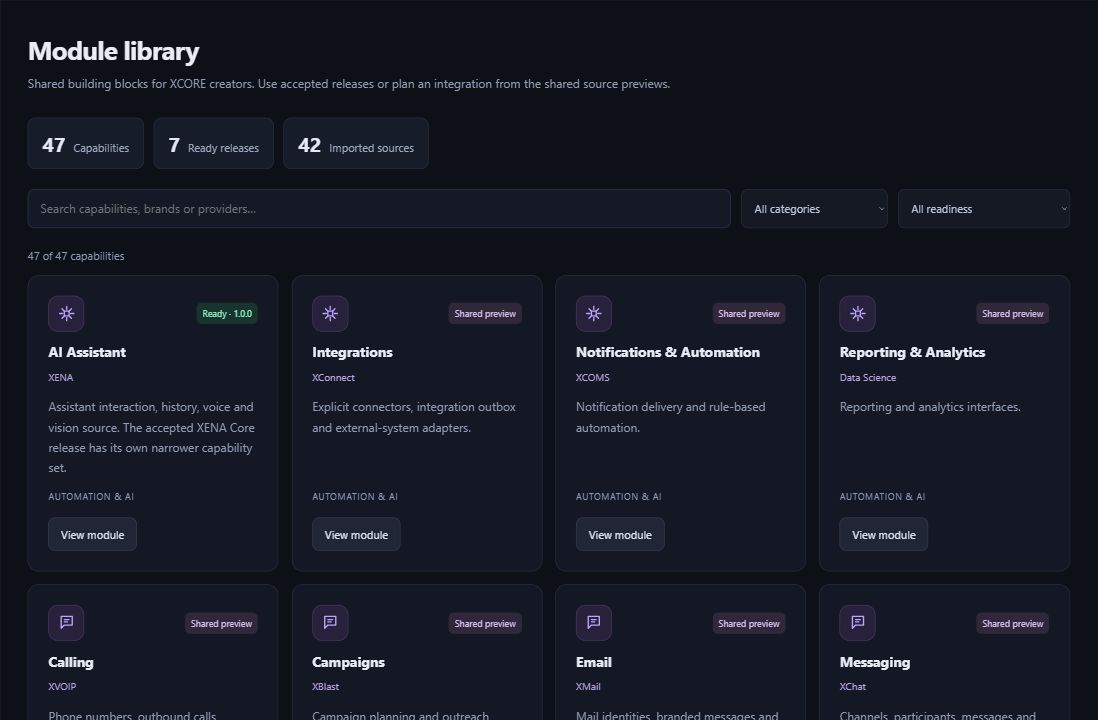
Data organization gives records a useful structure, names, relationships, ownership, and context. Within XCORE, collections should support the way people find, interpret, and use information across business functions rather than simply gather more files or tables.
Inside the creation layer · actual XCORE module-library capture, November 2, 2026. Release labels and account permissions apply.
THE PURPOSE IN PRACTICE
Structure data and metadata for discoverability, analysis, quality review, and existing-system integration.
An illustrative customer collection might relate organizations, contacts, jobs, and documents without combining them into one ambiguous record type. Define identifiers, categories, required metadata, and the meaning of dates. A useful structure lets a person answer a question without needing to know who originally created the data.
02
Keep quality and ownership visible
Scope source authority, duplicate handling, validation, classification, access, retention, and the process for changing the structure. Quality is not a one-time cleanup: new records and connected systems can reintroduce inconsistencies. Actual metadata controls, integration, and review workflows depend on the selected deployment.
PLAN YOUR IMPLEMENTATION
Match the scope to your needs.
Choose the business tools your organization needs. Our team can confirm the app, access, connections and setup for your company before implementation.
What is the difference between organization and storage?+
Storage keeps information available. Organization describes what it means, how records relate, where they belong, and how people find them. A large storage space can still be difficult to use if those decisions are missing.
How should a collection be named?+
Use a name that describes its subject and purpose clearly to the intended team. Define record types and ownership so similar names do not hide different meanings or create competing sources of truth.
Does cleaning old data solve data quality permanently?+
No. Validation, ownership, source rules, and review of new information are needed to maintain quality. A one-time cleanup can improve a starting point without preventing future duplicates or inconsistent entries.
Why connect metadata with permissions?+
Descriptions help people discover information, but discovery should respect access boundaries. A useful catalogue can explain the existence and purpose of a collection without exposing private records to unauthorized users.
THE PEOPLE’S CORPORATION
A future for people.
Personal control. Human opportunity. Stronger local economies and a voice for communities.