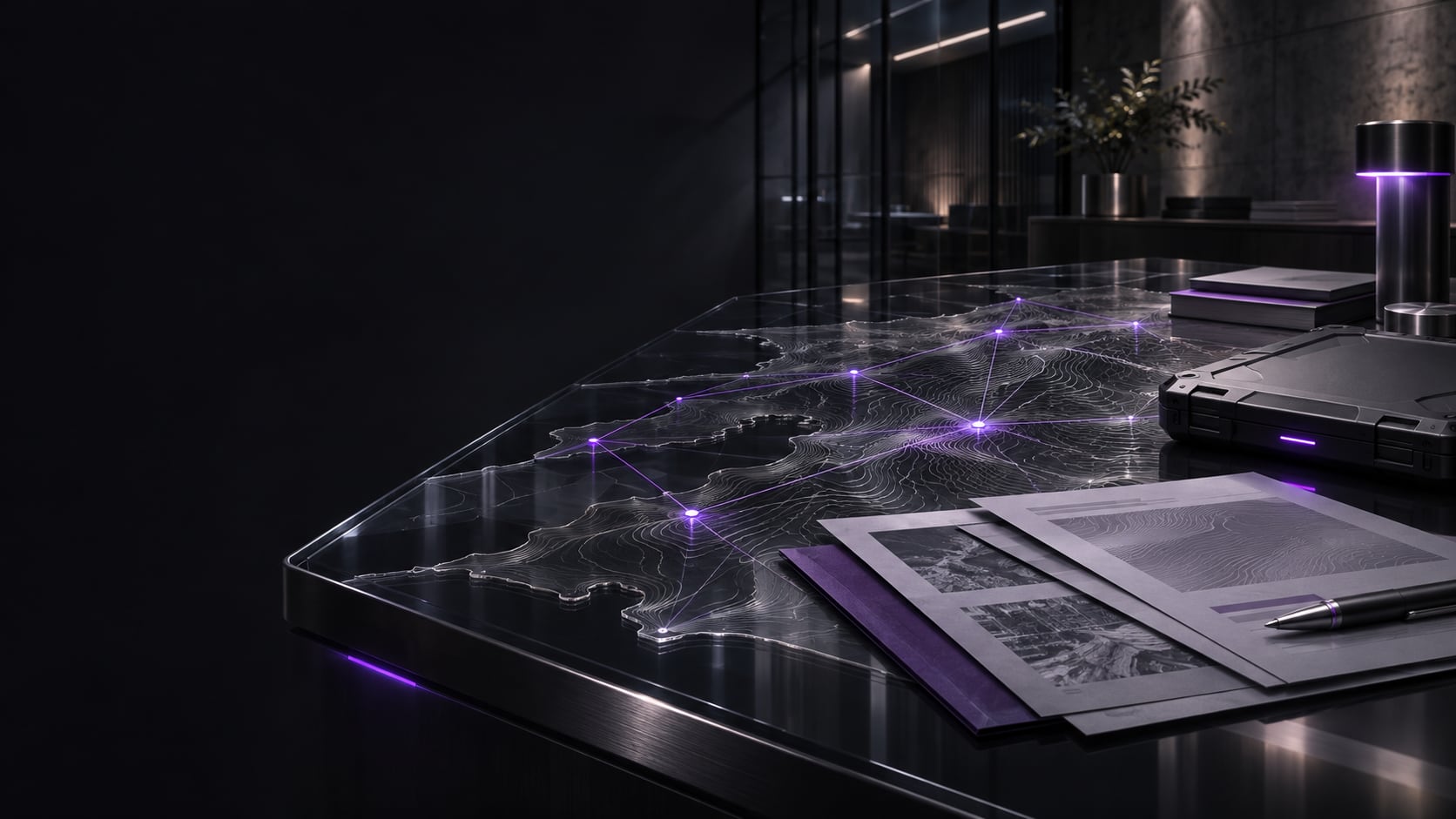
Concept illustration of a dark planning table with silver map contours, purple connections and report documents; not an actual ArmorX interface or operating facility.
Original Tactical campaign artwork · illustrative
XGLOBE TACTICAL RESPONSE GROUP

Intelligence & Documentation

A usable intelligence file connects the evidence, its source and the decisions that need review.

INTELLIGENCEPROTECTIONMOBILITYCONTINUITY
TACTICAL / INTELLIGENCE

Make the decision easier to examine

Intelligence and documentation support begins with a defined question and the material an authorized organization may use to answer it. Property records, imagery, field observations and correspondence can be connected into a file that makes sources, uncertainty and relevant relationships easier to examine.

Concept illustration of a dark planning table with silver map contours, purple connections and report documents; not an actual ArmorX interface or operating facility.
Original concept artwork · illustrative · ArmorX operations planning concept
WHAT THIS PAGE COVERS
01

Claims and incident information

02

AI supports organization

03

Field context

Understand the practical handoff

An illustrative assessment might ask what is known about a site condition before another inspection is planned. The useful result is not simply more material: it is an understandable index of the evidence, the gaps and the questions for the appropriate professional.

01 / Intelligence & Documentation

Claims and incident information

Organize property conditions, loss timelines, communications and contractor-side records according to the requester’s role. Connect the file to property claims, forensic documentation, geospatial work, authorized research and judicial-record services.

  • Property-condition documentation
  • Loss timelines
  • Evidence organization
  • Contractor-side records
Explore all 12 topics
  • Scope and estimate comparison
  • Communication timelines
  • Restoration intelligence
  • Portfolio dashboards
  • Before / during / after records
  • Missing-document identification
  • Photo, video, drone & sensor records
  • Metadata organization
02 / Intelligence & Documentation

AI supports organization

Search, comparison and structured analysis can help reviewers work through permitted material. Preserve the original record and validate significant findings with qualified humans. A model’s output is not a determination of cause, fraud, liability, crime, coverage or legal responsibility.

  • Evidence classification
  • Timeline reconstruction
  • Image, video & document comparison
  • Metadata organization
Explore all 12 topics
  • Duplicate and anomaly detection
  • Communication analysis
  • Property change analysis
  • Security incident intelligence
  • Recovery forecasting
  • Searchable records
  • AI-assisted summaries
  • Human-validated findings
Concept illustration of a dark planning table with silver map contours, purple connections and report documents; not an actual ArmorX interface or operating facility.
AN ILLUSTRATIVE WORKFLOW

Turn fragments into a record for a defined audience

A reviewer may receive images, field notes and several versions of a document. Useful intelligence work starts by identifying the question, preserving origins and separating confirmed observations from inferences. The format should suit the recipient: a claims professional, organizational decision-maker or other authorized reviewer may need different context. An illustrative review package makes the gaps visible as well as the material already collected.

Example for explanation · not a live incident or customer case
03 / Intelligence & Documentation

Field context

Identify which site observations, imagery, measurements or provider reports belong in the record. Field collection depends on permission, qualified personnel, suitable conditions and an agreed scope.

  • Field assessments
  • Property & infrastructure observations
  • Damage documentation
  • Personnel & contractor status
Explore all 12 topics
  • Fleet & equipment visibility
  • Authorized drone documentation
  • Security observations
  • Access events
  • Project progress reports
  • Incident reports
  • Mapping & dashboards
  • After-action reports
04 / Intelligence & Documentation

A file built for its audience

Owners, contractors, attorneys, insurers and other authorized professionals need different views and deliverables. Establish access, intended use, outstanding questions and professional review before sharing information.

  • Homeowners
  • Commercial Owners
  • Contractors
  • Restoration Companies
Explore all 9 topics
  • Property Managers
  • Municipalities
  • Claims Organizations
  • Lenders
  • Asset Managers
05 / Intelligence & Documentation

Move from fragments to review

Begin with the event and the records already available. Define the missing information, organize the evidence, verify sources and prepare a clear handoff rather than presenting unsupported conclusions.

    MAKE THE NEXT CONVERSATION USEFUL

    What to bring
    to the discussion.

    Start with a concise description. Additional records can follow through an appropriate agreed channel.

    Prepare an inquiry
    1. 01

      The decision or question the information must support

    2. 02

      Available source material and collection permissions

    3. 03

      The intended reviewer and delivery format

    QUESTIONS & ANSWERS

    Intelligence & Documentation
    Explained.

    What you can do and how to get started.

    What is the difference between information and a finding?

    Information is the underlying record or observation. A finding is an interpretation that needs support, context and appropriate review. The file should preserve that distinction.

    Can intelligence support replace an expert?

    No. Organized information can support engineering, legal, claims or operational review. Professional determinations remain with the people qualified and authorized to make them.

    Which pathway should I choose?

    Choose the question: property claims, forensic records, geospatial context, authorized research or judicial history. An initial non-sensitive description can help identify the appropriate scope.

    How is the permitted scope confirmed?

    Documentation and coordination are distinct from legal representation, public adjusting, licensed investigation and other regulated professional work.

    What should I prepare for this discussion?

    The decision or question the information must support; Available source material and collection permissions; The intended reviewer and delivery format. Begin with a concise non-confidential description. Additional records should follow through an appropriate agreed channel.

    SEARCH THE WHOLE ECOSYSTEM Press Esc to close
    FIND THE RIGHT FIT

    Your products, side by side.