Revenue tiers help frame the complexity of a conversation, but two businesses with the same revenue may operate very differently. A single-location service company and a multi-location retailer have different staffing, stock, reporting and integration needs. The tier framework is a starting vocabulary for those differences.
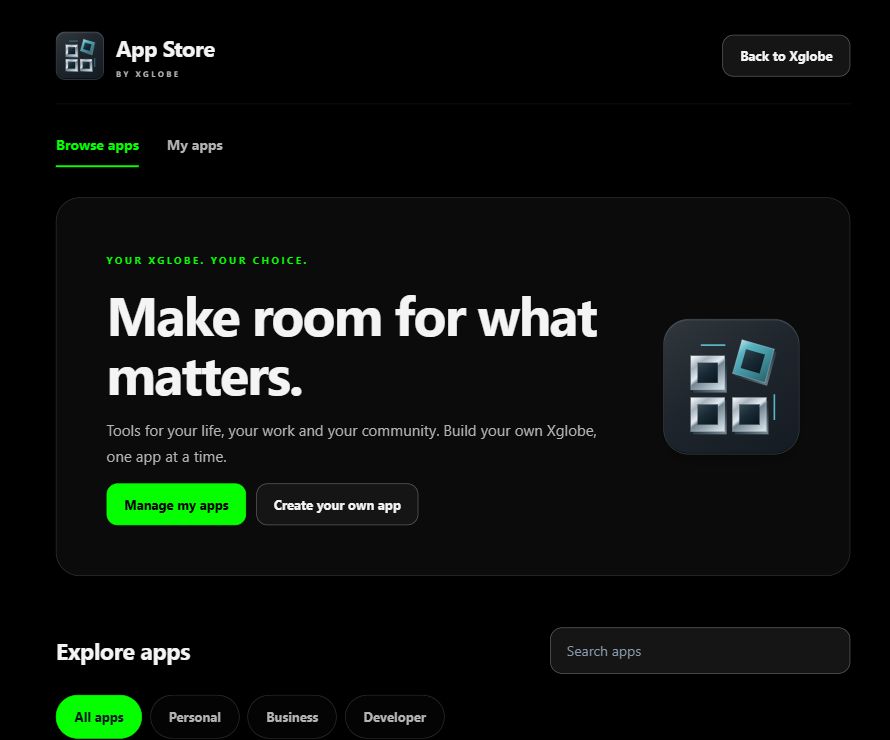
Inside the shared platform · actual App Store capture, November 2, 2026. This shows the platform catalogue, not a screenshot of every listed product.
THE PURPOSE IN PRACTICE
NanoCorp, MicroCorp, MegaCorp, and GigaCorp: a framework for matching business architecture and support to the scale of an organization.
Compare the number of locations, people, transactions, applications and decision makers alongside revenue. A smaller business with several disconnected channels may need more coordination than a larger business with a simple delivery model.
02
Compare complexity as well as turnover
The NanoCorp, MicroCorp, MegaCorp and GigaCorp labels describe increasing business scale. Operating complexity may grow differently: more locations add coordination, more products add information needs and more teams add handoffs. Revenue should therefore be read alongside the structure of the business, not as a measure of how sophisticated its systems must be.
BUILT AROUND THE REAL WORK
Business Solutions by Revenue
Revenue is a starting point for the conversation. Complexity, number of locations, operating needs, existing technology, and goals determine the actual engagement.
WHAT THIS CONNECTS
A clearer view of the work.
01
NanoCorp · under $1M
Start with foundational systems, focused guidance, and a practical sequence for the next stage.
02
MicroCorp · $1M–$10M
Connect growing teams, customer processes, and business systems around clearer operating priorities.
03
MegaCorp · $10M–$100M
Plan broader coordination, transformation, leadership support, and tailored business infrastructure.
04
GigaCorp · $100M–$1B
Discuss enterprise architecture, complex integrations, data migration, and organization-wide delivery.
PLAN YOUR IMPLEMENTATION
Match the scope to your needs.
Revenue bands describe the original XGlobe service framework. They are not fixed prices or eligibility guarantees. Current scope, responsibilities, deliverables, and commercial terms are set in a proposal.
No. They describe a planning framework. An actual proposal depends on the work, complexity, deliverables and responsibilities, rather than a fee inferred from a revenue label.
Which business tier should I choose?+
Describe your current scale and where coordination becomes difficult. The inquiry can identify the relevant scope even if you sit between bands or do not know the appropriate label.
What should I include in an inquiry about this work?+
Include approximate revenue context, team and location counts, the major applications and the point where coordination becomes difficult. Those details make a tier conversation useful without forcing the organization into a rigid package.
How does this support the XGlobe mission?+
The aim is useful capability for people and businesses: clearer work, understandable systems and a stronger basis for participation in the economy. Any actual engagement should connect that purpose to an agreed and observable improvement.
THE PEOPLE’S CORPORATION
A future for people.
Personal control. Human opportunity. Stronger local economies and a voice for communities.